

The landscape of property oversight has undergone a fundamental shift toward technical rigour and absolute accountability. With the Leasehold and Freehold Reform Act 2024 now firmly in place and the second phase of Awaab’s Law approaching, the requirements for professional residential block management services have never been more demanding. It's understandable if you feel frustrated by opaque service charge accounting or a lack of clarity regarding fire safety, as these failings put both your safety and your financial interests at risk.
We believe that effective management should act as a steady, reliable guide through this complex regulatory environment. This article demonstrates how a professional approach ensures statutory compliance, financial transparency, and the long-term preservation of your building’s structural integrity. We will outline the multi-disciplinary strategies required to maintain communal infrastructure and provide the clear, consistent communication that every resident deserves.
Table of Contents
Understanding the Scope of Professional Residential Block Management Services
Evaluating Block Management Companies: A Framework for Directors
Bespoke Management Solutions for Modern Residential Portfolios
Understanding the Scope of Professional Residential Block Management Services
Professional residential block management services encompass the comprehensive stewardship of a building's communal infrastructure and its intricate legal framework. Whilst a standard professional property management company might focus on individual tenancies, residential block management services require a broader perspective. It involves balancing the needs of various stakeholders whilst ensuring the physical fabric of the estate remains secure and compliant with ever-changing legislation. This holistic approach treats the building as a living asset that requires constant, expert attention to thrive.
The role has transitioned from a purely administrative function into a highly technical discipline. Modern agents must possess a deep understanding of structural surveying, fire safety engineering, and complex financial accounting. Acting as a neutral intermediary is essential; a professional agent maintains a professional distance to ensure that the interests of both freeholders and leaseholders are managed without bias. This is particularly vital when navigating sensitive service charge disputes or coordinating major works that require significant capital expenditure.
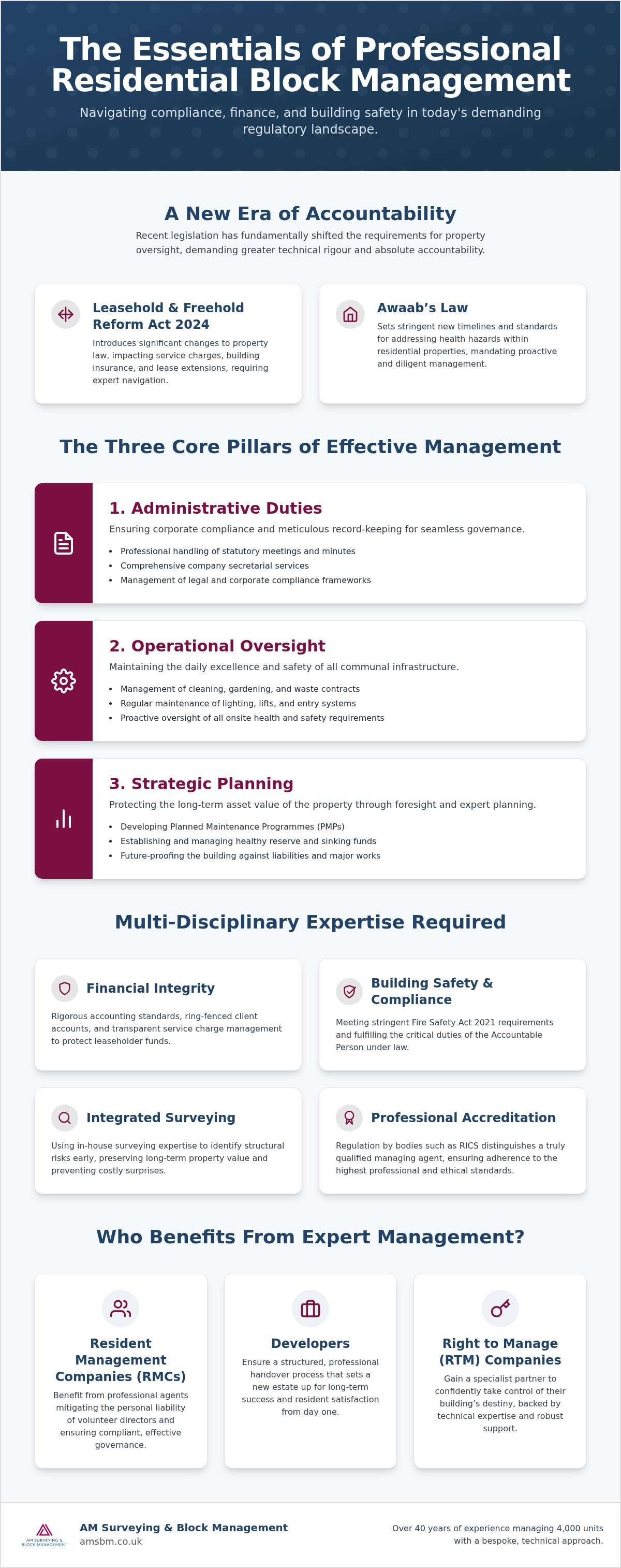
The Core Pillars of Effective Management
A robust management strategy is built upon three essential foundations that ensure a building functions as a safe and cohesive community:
Administrative duties: This includes the professional handling of minutes, statutory meetings, and company secretarial services to maintain corporate compliance.
Operational oversight: Ensuring the daily excellence of onsite requirements, such as cleaning, gardening, and the maintenance of communal lighting systems.
Strategic planning: Developing long-term maintenance programmes and reserve fund plans to protect the asset’s value over decades, rather than just focusing on immediate repairs.
Who Benefits from Professional Management?
Expert oversight is vital for various entities within the residential sector. Resident Management Companies (RMCs) often appoint professional agents to mitigate the personal liability of their volunteer directors. Developers benefit from a structured handover process that ensures a new estate is set up for success from day one. Additionally, those exercising their Right to Manage (RTM) require a specialist partner to take control of their building’s destiny with confidence. With over 40 years of experience managing 4,000 units, we understand that every block requires a bespoke approach rooted in technical expertise.
Financial Administration and Service Charge Management
Financial integrity forms the bedrock of trust between leaseholders and their managing agent. Within professional residential block management services, this begins with the implementation of rigorous accounting standards and the use of ring-fenced client bank accounts. These accounts ensure that leaseholder funds are held securely and separately from the agent’s own business capital, providing a vital layer of protection. Adhering to the standards set by the professional body for residential property managers ensures that every pound collected is tracked, allocated, and audited with absolute precision.
Managing ground rent and financial arrears requires a delicate balance of firmness and professional sensitivity. It's essential to address non-payment promptly to prevent shortfalls in the building's budget, whilst maintaining the respectful communication expected in a residential environment. Transparent reporting allows residents to see exactly how their contributions are utilised, from daily utility costs to the long-term preservation of the building's fabric.
Reserve Fund Planning and Sinking Funds
Protecting the long-term value of a property requires more than just meeting immediate costs. Professional agents utilise Planned Maintenance Programmes (PMPs) to calculate future liabilities, such as roof replacements or lift refurbishments. By establishing a healthy sinking fund, we avoid the sudden, heavy service charge spikes that can cause financial distress for residents. A well-funded reserve also ensures the building remains mortgageable in the eyes of lenders, supporting the resale value of individual units and the overall stability of the estate.
Section 20 Consultations and Major Works
When works exceed specific cost thresholds, usually £250 for any single leaseholder, a formal consultation is mandatory. The Section 20 process is a statutory safeguard for leaseholders that ensures they are fully informed and consulted before significant expenditure occurs. We manage the entire tender process to ensure value for money, obtaining competitive quotes from vetted contractors to maintain high standards of workmanship. If you have questions about your building's financial health, you can speak with our specialist team for guidance.
Prioritising Building Safety and Regulatory Compliance
The safety of residents remains the paramount responsibility of any managing agent. In 2026, the legislative burden has intensified, requiring a sophisticated understanding of the Fire Safety Act 2021 and the Building Safety Act 2022. Central to this is the identification of the "Accountable Person," a role that carries significant legal weight and demands meticulous record-keeping. Professional residential block management services provide the expertise needed to navigate these mandates, ensuring that every safety file is current and every risk is mitigated through proactive oversight.
Addressing cladding remediation and the issuance of EWS1 forms continues to be a complex challenge for many estates across the country. We act as a steady guide during these processes, coordinating with engineers and specialist surveyors to ensure remediation works meet the highest standards without placing undue stress on leaseholders. Regular health and safety risk assessments are not merely a checkbox exercise; they are a non-negotiable component of our service that protects both lives and property values. For residents looking to further protect their personal health in shared environments, you can visit mrsatest.co.uk to find out more about at-home screening kits.
Fire Safety and Communal Compliance
Effective fire safety relies on the rigorous maintenance of passive and active protection systems. This includes quarterly inspections of fire doors, the testing of communal smoke alarms, and ensuring emergency lighting remains fully functional at all times. We work closely with local fire authorities to establish clear evacuation or "Stay Put" policies, ensuring every resident understands the specific safety protocols for their block. This collaborative approach ensures that communal areas remain clear of hazards and compliant with the latest fire safety regulations.
Technical Surveying and Maintenance Oversight
Our unique background in surveying allows us to identify structural vulnerabilities, such as damp or masonry failure, before they escalate into costly repairs. We integrate modern technology for real-time fault reporting, whilst managing essential additional services including lift maintenance, Legionella water hygiene testing, and five-yearly electrical safety inspections. By overseeing these technical requirements with professional precision, we ensure your building remains a safe, compliant environment for all residents.
Evaluating Block Management Companies: A Framework for Directors
Choosing the right partner for residential block management services requires a structured evaluation of professional standing and operational capability. Directors must look beyond surface-level promises to identify the markers of a "safe pair of hands." Regulation by the Royal Institution of Chartered Surveyors (RICS) remains the gold standard in this regard. It ensures that an agent adheres to strict ethical codes, maintains professional indemnity insurance, and subjects their financial processes to rigorous external audits. Without these credentials, a board risks delegating significant responsibility to an unregulated firm with limited accountability.
Operational efficiency is often mirrored in an agent's investment in technology and their professional network. A modern resident portal should provide real-time updates on maintenance progress and financial status, ensuring leaseholders aren't left in the dark. Equally vital is the breadth of the agent's network; a seasoned professional should have established relationships with vetted contractors, specialist insurers, and solicitors who understand the nuances of leasehold law. This infrastructure allows for a more comprehensive service that protects the building's long-term interests.
Key Performance Indicators (KPIs) for Managing Agents
To assess an agent's performance effectively, directors should focus on three critical areas of service delivery:
Transparency of fees: Professional agents should operate with absolute clarity, avoiding hidden commissions on insurance premiums or contractor invoices.
Frequency of site visits: Regular, documented inspections are essential. Evaluate the thoroughness of their reports and how quickly they action identified issues.
Proactive maintenance behaviour: Look for evidence that the agent anticipates structural needs through planned maintenance, rather than simply reacting when components fail.
The Value of Specialist Right to Manage (RTM) Support
Navigating the legal pathway to take over building management is a complex undertaking that requires specialist expertise. An agent with specific Right to Manage support experience can guide leaseholders through the statutory notices and ensure a smooth transition from the previous agent. This support is vital for managing the transfer of service charge funds and technical documentation without legal friction. If you're considering a change in management for your estate, enquire about our professional evaluation process to see how we can support your board's objectives.
Bespoke Management Solutions for Modern Residential Portfolios
Modern estates require more than a one-size-fits-all approach. At AM Surveying & Block Management, we integrate surveying precision with dedicated management care to deliver residential portfolio solutions that meet the specific needs of developers and resident directors alike. Our background in technical assessment allows us to manage diverse properties, from intricate heritage conversions to expansive new-build estates, with the same level of professional rigour. By overseeing a national portfolio of 4,000 units, we've refined our residential block management services to scale effectively whilst maintaining the meticulous attention to detail that smaller blocks deserve.
We focus on providing a "safe pair of hands" for every client, ensuring that the integration of professional surveying expertise isn't just an add-on, but a core differentiator. This technical depth allows us to anticipate maintenance requirements that others might overlook, particularly in large-scale developments where communal infrastructure is complex. Our commitment to high standards remains unwavering across our entire portfolio, providing the stability and reliability that property owners expect from an established industry leader.
A Long-Standing Legacy of Reliability
Stability is a cornerstone of our service. Leveraging over 40 years of industry experience, our qualified team possesses a deep understanding of the local regulatory landscape, allowing us to solve complex property issues before they impact residents. We view professional management as a direct investment in a property’s future resale value. A well-maintained building with transparent finances and a clear compliance record is far more attractive to prospective buyers and lenders, ensuring your asset remains protected for the long term.
Next Steps: Securing Professional Oversight
Initiating a management review is the first step toward achieving the stability your building needs. The process of switching managing agents shouldn't be a burden; it can be handled with minimal disruption to building services through a structured, professional handover. We coordinate with outgoing agents to ensure all technical documentation and service charge funds are transferred accurately. To begin your transition toward a more reliable standard of care, you can learn more about our approach or contact us directly. Enquire about our professional block management services today to secure the expertise your property requires.
Future-Proofing Your Residential Asset
The transition toward a more regulated and transparent property sector in 2026 requires a partner that combines technical surveying precision with absolute financial integrity. As an RICS Regulated Firm with 40+ years of professional expertise, we've seen how professional residential block management services act as the defining factor in preserving both resident safety and long-term asset value. It's no longer enough to simply react to repairs; success now demands a proactive strategy rooted in statutory compliance and robust reserve fund planning.
Whether you're navigating the complexities of the Building Safety Act or seeking specialist Right to Manage (RTM) support to take control of your building's future, the right guidance ensures a seamless experience for all stakeholders. Professional oversight isn't just an administrative requirement; it's a strategic investment in the stability of your community. We're ready to provide the steady, reliable leadership your property deserves.
Discover how our professional block management services can protect your investment and bring lasting peace of mind to your board of directors.
Frequently Asked Questions
What are the primary responsibilities of a residential block management company?
A residential block management company is responsible for the holistic stewardship of a building's communal fabric and its legal obligations. This includes coordinating essential repairs, managing onsite contractors, and ensuring the block remains compliant with evolving fire safety regulations. They act as the central point of contact for leaseholders whilst maintaining the financial health of the estate through diligent service charge administration.
How is the service charge calculated and what does it typically cover?
Service charges are calculated based on an annual budget that estimates the forthcoming costs of maintaining the building's shared infrastructure. This typically covers communal utility bills, building insurance, professional management fees, and general maintenance like cleaning or gardening. A portion is also often allocated to a reserve fund to prepare for significant future works, such as roof repairs or lift refurbishments.
Can leaseholders choose their own residential block management services?
Leaseholders can only choose their residential block management services if they are directors of a Resident Management Company (RMC) or part of a Right to Manage (RTM) company. In traditional leasehold structures where the freeholder retains control, the choice of agent rests solely with the landlord. If you're unhappy with the current oversight, exercising your legal right to manage is often the most effective route to gaining control.
What is the difference between an RMC and an RTM company?
An RMC is typically a company established during the original development of the block with its structure defined within the property leases. Conversely, an RTM company is a legal vehicle created by leaseholders who have exercised their statutory right to take over management from the landlord. Whilst both allow for resident control, the RTM process is a specific legal pathway used to displace a landlord's chosen managing agent.
How does the Building Safety Act 2022 affect residential block management?
The Building Safety Act 2022 fundamentally changed the landscape by introducing the role of the "Accountable Person" for higher-risk buildings. It requires managing agents to maintain a "golden thread" of digital information regarding building safety and to produce comprehensive safety case reports. These measures ensure that structural and fire safety risks are identified and managed with a level of technical rigour previously not mandated by law.
What should we do if we are dissatisfied with our current managing agent?
You should first review your management agreement to understand the notice periods and termination clauses currently in place. If the building is managed by an RMC or RTM company, the directors can vote to terminate the contract and appoint a new firm. For leaseholders under a landlord-managed block, the options include applying to a tribunal for a manager's appointment or initiating a collective Right to Manage claim.
Are block management fees regulated in the UK?
Block management fees are not currently subject to statutory price caps in the UK, but they are governed by the requirement that all service charges must be "reasonably incurred." Professional agents who are members of RICS or The Property Institute must adhere to strict codes of practice regarding fee transparency. It's common for fees to be structured as a fixed annual amount per unit to ensure cost predictability for all residents.
How often should a managing agent visit the residential block?
The frequency of site visits is determined by the specific management contract, but a professional agent should typically visit at least once per quarter. For larger or more complex estates, monthly inspections are often necessary to ensure operational standards are met and to identify maintenance issues before they escalate. These visits are essential for producing the thorough reports that inform long-term strategic planning.