

In 2026, the era of passive property oversight is officially over; if your managing agent isn't treating your building as a critical regulatory environment, they're leaving you exposed to significant legal risk. It's a reality that many residents and directors now face as the full weight of the Building Safety Act and the 2024 Reform Act comes to bear on every aspect of leasehold block management. You likely feel the growing pressure of rising service charges and the complex requirements of the Fire Safety Act, all whilst wanting the simple assurance that your home is being managed with integrity and competence.
We understand that the lack of transparency in financial reporting and the silence of unresponsive agents can be more than just frustrating; they can threaten your property's value. This guide provides a clear roadmap to navigate these complexities, promising a shift towards absolute compliance and professional excellence. You'll learn how to demand higher standards of transparency and how to implement the planned maintenance programmes necessary to safeguard your investment. We'll examine the specific legal mandates effective this year, ensuring your building remains a safe, well-governed place to live.
Table of Contents
What is Leasehold Block Management in the 2026 Regulatory Landscape?
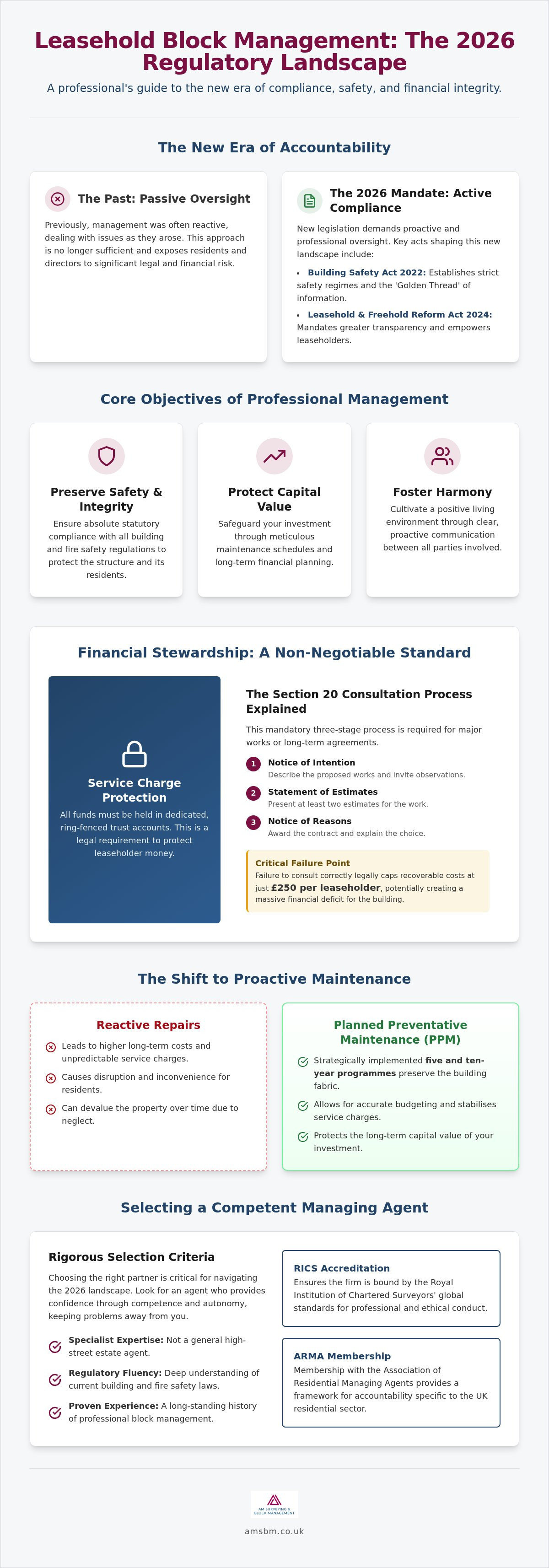
At its core, leasehold block management is the professional administration of residential buildings where individual units are held on long-term leases. It involves a complex orchestration of financial, legal, and technical disciplines to ensure a building functions safely and efficiently. This Building Management Overview illustrates how the role has evolved from simple rent collection to a high-stakes regulatory duty. In 2026, the landscape is defined by the phased implementation of the Leasehold and Freehold Reform Act 2024, which has significantly shifted the balance of power toward leaseholders by mandating greater transparency and easier routes to lease extensions of up to 990 years.
Professional management now requires a level of technical expertise that general high-street estate agents simply aren't equipped to provide. Whilst a sales agent might understand the local market, they often lack the specialist training to handle the Building Safety Act 2022 or the specific requirements of Section 20 consultations. For those seeking a more direct hand in their building’s future, professional block management offers the necessary framework to maintain standards whilst ensuring all legal obligations are met without compromise. It's about moving away from reactive fixes and towards a structured, professional oversight model.
The Core Objectives of Professional Management
The primary goal is the preservation of the building's structural integrity and the safety of its inhabitants. This means ensuring absolute statutory compliance with the Fire Safety (Residential Evacuation Plans) (England) Regulations 2025, which came into force in April 2026. Beyond safety, professional managers protect the long-term capital value of the property. They achieve this by organising meticulous maintenance schedules and fostering a harmonious living environment through clear, proactive communication between all parties. They act as the steady hand that balances the needs of the freeholder with the rights of the leaseholders.
Key Regulatory Bodies and Accreditations
Navigating this environment requires a partner with recognised qualifications. The Royal Institution of Chartered Surveyors (RICS) sets the global standard for professional conduct, whilst the Association of Residential Managing Agents (ARMA) provides a framework for accountability specifically within the UK residential sector. For directors of Resident Management Companies, choosing an accredited firm is a vital safeguard. It ensures that the agent is bound by a strict code of practice, providing the security necessary to manage complex financial trusts and high-risk building safety files with complete integrity.
Financial Stewardship: Service Charges and Section 20
Financial integrity is the bedrock of professional leasehold block management. In 2026, it's a legal requirement that all service charge funds are held in dedicated, ring-fenced trust accounts. This ensures that leaseholder money is protected and used solely for the building's operation. Choosing a partner with 40 years of industry experience provides the "safe pair of hands" needed for such complex compliance. Professional agents avoid mid-year "surprises" by meticulously organising annual budgets that reflect actual anticipated costs. Transparency is further reinforced by year-end accounts that undergo independent certification, providing residents with absolute clarity. This rigour extends to ground rent administration, navigating the latest restrictions following the 2024 Reform Act.
The Section 20 Consultation Process Explained
Statutory consultation is mandatory when any single leaseholder is expected to contribute more than £250 toward qualifying works. It also applies to long-term agreements exceeding 12 months where the cost to any leaseholder is more than £100 per year. In 2026, failing to follow the three-stage process, consisting of the Notice of Intention, Statement of Estimates, and Notice of Reasons, is a critical error. If an agent fails to consult correctly, the recoverable amount is legally capped at just £250 per unit. This often leaves a massive financial deficit for the building. Such failures are frequently the catalyst for leaseholders to explore their Right to Manage if they feel financial stewardship is lacking.
Reserve Funds and Long-Term Financial Planning
A professional agent distinguishes between a sinking fund for specific long-term replacements and a general reserve fund for unforeseen contingencies. Effective leasehold block management relies on a strategic approach to capital expenditure, calculating appropriate reserve levels based on professional surveys. By building this financial cushion, agents prevent the need for sudden, large levies that can distress residents. Well-funded reserves don't just maintain the building; they significantly enhance the saleability of individual flats. Prospective buyers and lenders look for evidence of stable financial health before committing. If you are concerned about the financial transparency of your current arrangements, you can speak with our specialist team for a confidential review.
Statutory Compliance: Fire Safety and Building Standards
Compliance is no longer a matter of simple administration; it's a rigorous legal mandate that carries significant liability. Under the Building Safety Act 2022, a professional agent often acts as the 'Accountable Person' or provides essential support to the 'Principal Accountable Person' in high-risk buildings. This role involves the meticulous management of the 'Golden Thread' of building information, which is a digital record ensuring that safety data is accurate and accessible throughout the property's lifecycle. Expert leasehold block management ensures that routine safety inspections, such as Health and Safety audits, Fire Risk Assessments (FRA), and asbestos surveys, are conducted by qualified professionals. Such oversight is now a prerequisite for satisfying modern insurance requirements, as providers increasingly demand evidence of robust risk management before granting coverage.
The distinction between the roles of a Resident Management Company (RMC) and their professional agent is often blurred, yet the legal weight rests on whoever is designated as the responsible person. For residents seeking impartial guidance on these complex legalities, The Leasehold Advisory Service offers a vital resource for understanding statutory rights and obligations. Ensuring these standards are met is a core part of our block management service, providing the "safe pair of hands" required to navigate this high-stakes environment.
Fire Safety Act 2021 and Fire Door Compliance
The Fire Safety Act 2021 introduced mandatory inspections for flat entrance doors and communal fire doors in residential buildings. Agents must now coordinate quarterly checks of communal doors and annual inspections of flat entrance doors to ensure their fire-stopping integrity remains uncompromised. This technical oversight extends to communicating evacuation strategies to residents. Whether the building operates a 'Stay Put' or 'Simultaneous Evacuation' policy, clear and regular communication is a critical duty that ensures every occupant knows exactly how to behave in an emergency.
Cladding and External Wall Systems (EWS1)
Managing agents play a pivotal role in cladding remediation projects, acting as the primary liaison between the RMC and the Building Safety Regulator. They navigate the complex EWS1 process to facilitate leaseholder remortgaging and sales, which have historically been stalled by cladding concerns. Professional leasehold block management provides the technical leadership needed to oversee these high-value projects whilst ensuring all safety certifications are current and legally robust.
Effective Maintenance and the Role of Technology
Professional leasehold block management has moved decisively away from a reactive repair model toward a structured system of proactive care. Transitioning to this approach involves the implementation of a 5-year or 10-year Planned Preventative Maintenance (PPM) programme. These strategic plans provide the foresight needed to stabilise annual budgets, preventing the sudden, high-cost levies that often cause distress amongst leaseholders. By identifying necessary works well in advance, agents can organise repairs whilst minimising disruption to residents' daily lives, ensuring the building remains both functional and aesthetically pleasing. This foresight is especially critical given the expansion of Awaab’s Law on 30 November 2026, which mandates strict timeframes for addressing hazards like broken heating or drainage issues.
Selecting and Managing Contractors
The quality of a building's upkeep is only as good as the contractors performing the work. A rigorous vetting process is essential, focusing on professional competence, health and safety accreditation, and adequate insurance coverage. To ensure value for money, professional agents conduct competitive tendering amongst local trades, balancing cost-efficiency with the high standards required for residential blocks. The agent’s role doesn't end at the award of the contract; it includes regular site inspections and a formal sign-off process to ensure completed works meet the specified standards before any payment is released from the service charge fund.
Technology in Block Management
Modern management portals have revolutionised the communication rhythm between residents and agents. These platforms allow leaseholders to report repairs instantly and track the progress of ongoing works in real-time. Digital document stores provide a secure, central hub for essential records, including leases, insurance certificates, and the safety reports that form part of the 'Golden Thread' of building information. This data-driven approach significantly reduces administrative overheads and minimises the risk of human error. If your current management lacks this level of technical integration and proactive planning, you can enquire about our professional standards to see how we can assist.
Selecting the Right Managing Agent for Your Block
Choosing a partner for leasehold block management requires more than a simple comparison of annual fee structures; it demands a rigorous assessment of technical depth and regulatory readiness. A dedicated specialist understands the nuances of the Building Safety Act in a way a generalist high-street agency cannot. During the tendering process, RMC directors should ask specific questions about an agent's approach to the "Golden Thread" of information and their strategy for the 2024 Reform Act. A significant red flag is a low base fee that's offset by hidden administrative charges or undisclosed commissions on insurance premiums. At AMSBM, our 40-year history ensures we act as a "safe pair of hands" for your property, providing the stability that only decades of experience can offer.
The Handover Process: Switching with Confidence
If your current agent is underperforming, directors have clear legal pathways to initiate change. The transition period is often a source of resident anxiety, so a professional firm prioritises a seamless transfer of financial records and safety documentation. We manage this process with methodical precision, ensuring that historical data and current budgets are integrated without operational gaps. This structured approach maintains building stability whilst providing the board with the transparency they've likely been missing. It's about ensuring the new management starts with a complete and accurate understanding of the building's standing from day one.
For those managing new-build properties in Ireland, this clarity starts with a detailed inspection of the physical asset; you can visit Snag My Home to see how professional snagging services help establish this baseline of quality.
Why AM Surveying & Block Management Stands Out
Our firm is defined by an exclusive focus on residential leasehold block management and Right to Manage (RTM) support. We manage a portfolio of 4,000 units with a sense of quiet confidence, recognising that every building presents unique challenges. We don't apply a one-size-fits-all model. Instead, we provide tailored solutions that prioritise compliance and long-term asset preservation. For those seeking to take control of their building's governance, you can learn more about our Right to Manage support to explore your options. Our experience ensures your building is not just managed, but protected for the future.
Securing the Future of Your Residential Block
The regulatory environment of 2026 demands a level of precision that goes far beyond simple property maintenance. Effective leasehold block management now hinges on a deep understanding of the 2024 Reform Act and the stringent fire safety mandates that protect every resident. By prioritising transparent financial stewardship and implementing data-driven maintenance programmes, you ensure your building remains a safe and valuable asset. We've explored how the right technology and a proactive approach to Section 20 consultations can transform the living experience for leaseholders whilst safeguarding the interests of directors.
With over 40 years of specialist expertise and a portfolio of 4,000 residential units managed with care, our team of dedicated RTM and RMC specialists provides the steady guidance needed in this complex landscape. It's time to move toward a management model that values integrity and technical excellence above all else. You deserve the peace of mind that comes from a partner who truly understands the weight of their responsibility. Your property is in safe hands.
Request a professional management proposal from our expert team and take the first step toward a safer, more transparent future for your building.
Frequently Asked Questions
What is the difference between a freeholder and a managing agent?
The freeholder owns the building's structure and the land it sits upon, whilst a managing agent is a professional firm appointed to oversee the building's daily operation. The agent acts as the representative for the freeholder or a Resident Management Company (RMC) to ensure statutory compliance and financial transparency. Their role is to implement the decisions of the board and maintain the property according to professional standards.
Can leaseholders force a change of managing agent?
Leaseholders have the legal right to change their agent by exercising the Right to Manage (RTM), which allows them to take over management responsibilities without needing to prove fault. If the building is already managed by an RMC, the directors can simply terminate the existing contract according to its specific notice period. This process ensures that residents maintain control over who provides their leasehold block management services.
Are service charges capped under the 2024 Reform Act?
The Leasehold and Freehold Reform Act 2024 does not impose a fixed monetary cap on service charges, but it does introduce more rigorous requirements for transparency and "reasonableness". All costs must be clearly justified and documented. Leaseholders now have enhanced rights to challenge unfair expenses through a tribunal, ensuring that managing agents remain accountable for every pound spent from the service charge fund.
How often should a Fire Risk Assessment (FRA) be carried out?
A Fire Risk Assessment should typically be reviewed annually, especially for high-rise residential buildings or those with complex safety systems. It's a legal requirement to update the assessment if there's a significant change to the building's structure or its occupancy. Maintaining a current FRA is a critical part of leasehold block management, ensuring the safety of all residents and satisfying modern insurance requirements.
What happens if a leaseholder refuses to pay their service charge?
When a leaseholder fails to pay, the managing agent will initiate a formal debt recovery process, which may include late payment interest and administrative fees. If the debt remains unpaid, the agent may pursue court action to secure a judgment. In extreme and persistent cases, the freeholder can seek the forfeiture of the lease, though this is always treated as a final resort after all other avenues are exhausted.
Does a managing agent handle the sale of individual flats?
Managing agents do not handle the marketing or sales process, as this is the responsibility of a high-street estate agent or a specialist luxury firm like King Estates for overseas investments. However, they are essential to the conveyancing process because they provide the LPE1 (Leasehold Property Enquiries) pack. This pack contains vital information about the building's financial health, insurance details, and any upcoming major works, which solicitors require to complete the transaction for a prospective buyer.
What is a Resident Management Company (RMC) director's liability?
Directors of an RMC hold a fiduciary duty to act in the best interests of the company and its members. Whilst they carry the responsibility for the building's governance, they can be held personally liable for breaches of duty or negligence. Professional agents mitigate this risk by ensuring that robust Directors and Officers (D&O) insurance is in place and by providing the technical expertise needed to make informed decisions.
How are major works funded in a block of flats?
Major works are primarily funded through a sinking or reserve fund, which is built up over several years to spread the cost of large projects like roof replacements. If the current reserves are insufficient to cover the total expenditure, the managing agent will issue a supplementary service charge levy. This process must follow a formal Section 20 consultation to ensure all leaseholders are properly informed and consulted on the costs.