

The long-term reputation of a new build development is frequently determined months before the first resident receives their keys. Whilst construction quality is paramount, the transition from a site under development to a functional living community represents a critical risk phase that many firms overlook until it's too late. You likely recognise that the increasing weight of regulation, particularly with the transition of the Building Safety Regulator to an independent body in early 2026, has made the margin for error virtually non-existent. This guide explores why early-stage block management for developers is no longer a post-completion afterthought but a fundamental strategic asset that protects your brand and ensures every regulatory requirement is met.
It's understandable to feel the pressure of addressing the Fire Safety Act 2021 alongside newer 2026 requirements, such as the Building Safety Levy and mandatory second staircases for buildings over 18 metres. We will demonstrate how a proactive management partnership creates accurate service charge budgets that assist your sales teams and mitigates long-term liability through meticulous compliance. By the end of this article, you'll understand how to achieve a seamless, snag-free handover that satisfies the Building Safety Regulator and provides residents with a stable, well-managed environment from day one.
Table of Contents
The Critical Role of Block Management in Modern Property Development
Pre-Completion Consultancy: Optimising Design for Long-Term Management
Professional Block Management: Enhancing Asset Value Nationally
The Critical Role of Block Management in Modern Property Development
In the current regulatory climate, block management for developers has evolved from a post-construction handover task into a fundamental pre-construction strategy. It's no longer sufficient to view management as a simple caretaking function. Instead, it requires a deep integration of property management principles into the very design and planning stages of a development. A professional managing agent acts as the essential bridge between the technical construction teams and the future leaseholders. This ensures that the physical asset is not only built to high standards but is also operationally viable and compliant from the moment the first resident arrives.
This shift toward complex asset and compliance management is driven by a need for stability and reliability. Modern developments are intricate ecosystems involving sophisticated fire safety systems, communal energy schemes, and high-specification shared spaces. Without early professional oversight, these elements can become liabilities. By establishing a proactive partnership during the design phase, developers ensure that every operational nuance is considered. This protects their long-term brand and reputation in an increasingly scrutinised market where quality of management is a key differentiator.
Why Early Appointment is a Strategic Advantage
Appointing a managing agent early in the development cycle provides a significant competitive edge. It allows for the thorough mobilisation of the building, ensuring that staff, contracts, and safety protocols are fully operational well before the final sales phase. This readiness reduces friction during the move-in period, which is often the most stressful time for buyers. Additionally, having a reputable management firm already in place serves as a powerful USP in marketing collateral. It reassures prospective purchasers that their investment will be maintained to professional standards by a safe pair of hands.
Protecting Your Reputation Beyond the Sale
The first 12 months of occupancy are the most critical for a developer's reputation. During this period, resident dissatisfaction can escalate quickly if snagging issues are not handled with care. A professional managing agent serves as the composed face of the development, managing resident expectations and facilitating communication whilst construction teams address minor defects. This buffer ensures that the developer can focus on their next project. They can rest easy knowing that resident relations are being fostered by experts who prioritise transparency and high standards of service.
While regulatory frameworks vary by region, the principles of high-quality construction remain universal; for instance, you can check out HMJ Contracting to see how professional standards are applied in the renovation and building sector.
Pre-Completion Consultancy: Optimising Design for Long-Term Management
Effective block management for developers begins at the conceptual stage, long before the first brick is laid. By integrating professional management consultancy into the design phase, firms can avoid common pitfalls that lead to inflated service charges and operational inefficiencies. Our surveyor-led approach ensures that communal areas are designed with durability and ease of maintenance in mind. This involves scrutinising material choices and plant room layouts to ensure they don't just look impressive on day one, but remain cost-effective to service for decades.
During the planning and Section 106 process, a robust Management Strategy is increasingly required by local authorities. This document outlines how the building will function, from refuse collection to the maintenance of shared public realms. Adopting the principles of the Soft Landings Framework allows us to align the design intent with the reality of building occupation. It ensures that smart building technologies, such as integrated access control and communal heating systems, are implemented in a way that provides genuine value to residents without creating an unmanageable financial burden. Key areas of focus include:
Optimising the layout of communal plant rooms to reduce specialist contractor call-out fees.
Specifying hard-wearing finishes in high-traffic lobbies to extend the lifecycle of the building fabric.
Ensuring clear access for window cleaning and external cladding inspections from the outset.
Service Charge Modelling and Budgeting
Sales teams require accurate and attractive service charge budgets to secure off-plan reservations. We provide transparent financial forecasting that balances the desire for luxury amenities with long-term affordability. By modelling realistic sinking funds and operational costs early on, we prevent the "budget shock" that can lead to early resident dissatisfaction. If you are currently finalising your site's operational budget, you may wish to speak with our consultancy team for a technical review.
Sustainability and Biodiversity Net Gain (BNG)
Modern developments must now navigate complex environmental requirements, including Biodiversity Net Gain (BNG) and EV charging infrastructure. Managing these ecological assets requires a specialised approach to ensure the long-term health of the estate whilst meeting 2026 regulatory standards. Efficient plant oversight and renewable energy management aren't just about compliance; they're essential for reducing the carbon footprint of managed blocks and controlling utility costs for future leaseholders.
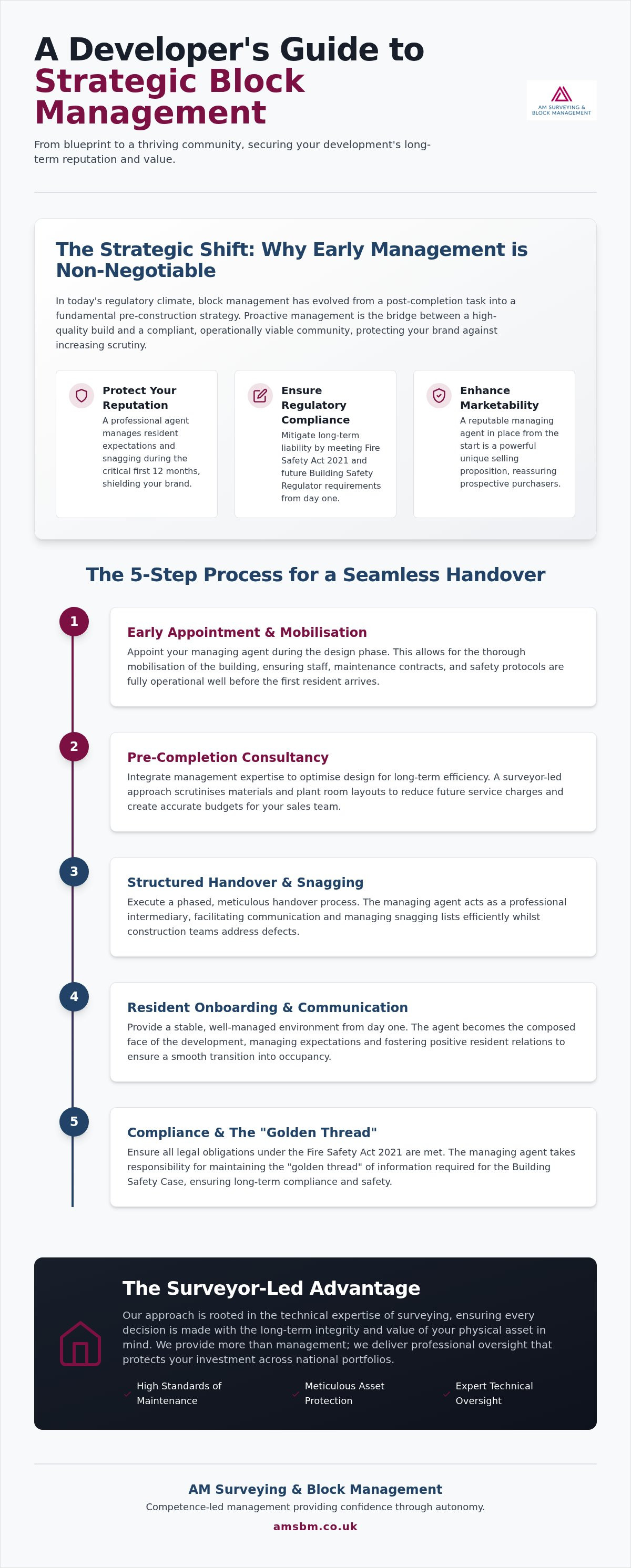
Navigating the Handover: A 5-Step Process for Developers
The handover process represents a critical pivot point where the focus shifts from construction delivery to operational excellence. For many firms, this transition from "Project Manager" control to "Managing Agent" control is where risks are most likely to manifest. Implementing a structured approach to block management for developers ensures that the "Golden Thread" of building information is preserved and that every health and safety file is correctly catalogued before the first resident arrives. A methodical transfer of data isn't just best practice; it's a requirement for 2026 compliance standards.
Step 1 to 3: Documentation, Inspection, and Mobilisation
The initial steps focus on technical verification and operational readiness. We conduct comprehensive site inspections to ensure communal areas meet management standards, whilst simultaneously reviewing specialist contractor agreements for communal plant. This phase is about more than just checking snags. It's about verifying that all O&M manuals are accurate and that the building is fully mobilised for immediate occupancy. Key actions during this phase include:
Auditing health and safety files and ensuring fire risk assessments are complete.
Establishing on-site security protocols and, where required, concierge staffing.
Confirming that all plant warranties are properly assigned and the maintenance schedule is clear.
Step 4 to 5: Leaseholder Welcome and Ongoing Governance
Once the physical assets are secured, the focus shifts to the residents. Creating detailed Welcome Packs is essential to define leasehold responsibilities and building rules from day one. We also facilitate the first Resident Management Company (RMC) meetings where applicable, establishing professional governance early in the building's life. By providing clear, digital communication channels for reporting defects, we maintain the developer's reputation whilst ensuring the building's long-term health. This structured dialogue prevents minor issues from escalating into significant resident dissatisfaction, allowing the developer to exit the project with their brand intact.
Regulatory Compliance: Fire Safety and Building Standards
The introduction of the Fire Safety Act 2021 has significantly heightened the scrutiny placed on residential handovers, particularly regarding external wall systems and flat entrance doors. When implementing block management for developers, the focus must shift towards a regime of continuous compliance. A managing agent's role is critical in developing and maintaining the Building Safety Case, which serves as the primary evidence of a building's safety for its residents and the regulator. This process begins with day-one fire door inspections and the establishment of a robust maintenance schedule that leaves no room for ambiguity.
Whilst our expertise is frequently utilised during the construction of new builds, we also provide essential oversight for developers managing older portfolios. We handle complex Section 20 consultations for major works, ensuring that legacy assets are brought up to modern standards without compromising legal or financial transparency. This comprehensive approach ensures that every property under our care, regardless of age, meets the stringent requirements of the current safety regime.
The Building Safety Act 2022 and the 'Accountable Person'
The transition from developer to management requires a clear definition of the "Accountable Person" and their legal responsibilities. We facilitate the digital transfer of the "Golden Thread" of information, ensuring that safety-critical data is accessible and accurate. For Higher-Risk Buildings (HRBs), this transparency is vital to satisfy the Building Safety Regulator, which transitioned to an independent statutory body in January 2026.
Insurance and Risk Management
Securing comprehensive buildings insurance is increasingly dependent on a developer's ability to demonstrate proactive risk management. We conduct initial Fire Risk Assessments (FRA) and Health & Safety audits immediately upon handover to establish a clear safety baseline. By maintaining meticulous records and evidence of compliance, we significantly mitigate the developer's long-term liability. If you require expert guidance on meeting these stringent safety standards, you should contact our compliance team for a technical consultation.
Professional Block Management: Enhancing Asset Value Nationally
Professional block management for developers is a vital component in preserving the long-term capital value of a portfolio. Developers operating across multiple regions require a partner capable of delivering consistent service levels regardless of location. This national coverage ensures that operational standards, safety protocols, and resident communications are uniform across a developer's entire estate. By maintaining high standards from the outset, professional block management for developers fosters a sense of community and trust that directly supports the marketing and sales of future development phases.
Maintaining consistent technical standards across a national portfolio requires the right equipment for every task; for instance, MileageBlocker.com offers specialised, high-performance tools for professionals who need to manage vehicle data during testing and transit.
Tailored Solutions for RMCs and Freeholders
Every development has a unique exit strategy. Some firms prefer to retain the freehold to secure long-term ground rent income, whilst others facilitate a complete handover to a Resident Management Company (RMC). We adapt our services to suit these specific needs, providing comprehensive financial administration that includes ground rent collection and detailed service charge reconciliation. For older developments looking to take control, we also provide expert Right to Manage (RTM) support, ensuring that the legal transition is handled with technical precision and care.
The AMSBM Difference: Surveying Expertise
What distinguishes our approach is a foundation built on 40 years of surveying experience. This technical background allows us to move beyond reactive "break-fix" management toward a model of proactive asset protection. We currently oversee a national portfolio of 4,000 units, applying a surveyor's eye to every maintenance plan and compliance audit. This expertise prevents the gradual degradation of the building fabric and ensures that service charge funds are spent efficiently. It's this "safe pair of hands" philosophy that provides developers with the stability they need to focus on their next project. To ensure your development is managed to the highest professional standards, you can partner with AM Surveying & Block Management for your next development.
Securing the Future of Your Development
The transition from construction to occupation is a defining moment for any project. As we have explored, integrating professional block management for developers at the earliest opportunity ensures that design decisions are grounded in operational reality and that regulatory compliance is never left to chance. By prioritising the "Golden Thread" of information and establishing accurate service charge models, you provide a stable environment that protects your reputation and satisfies the most stringent building safety standards.
With over 40 years of property expertise and a national portfolio of 4,000 units, AM Surveying & Block Management acts as a steady partner throughout this lifecycle. We provide specialist Fire Safety Act 2021 compliance support and surveyor-led oversight that prevents costly reactive maintenance. Our team is ready to help you navigate the complexities of modern property oversight with a methodical and reliable approach.
Request a Professional Proposal for Your Development
We look forward to ensuring your next project is a resounding success from the very first day of occupancy.
Frequently Asked Questions
When is the best time for a developer to appoint a block managing agent?
The optimal time is during the design or planning stage. Engaging a specialist in block management for developers early allows for technical input on communal layouts and service charge modelling. This proactive approach prevents costly design errors that might otherwise inflate future maintenance costs or complicate the eventual handover.
What documents does a managing agent need from the developer at handover?
Developers must provide the "Golden Thread" of building information to ensure a safe transition. This includes O&M manuals, health and safety files, fire risk assessments, and as-built drawings. Managing agents also require all specialist warranties and maintenance contracts for communal plant to ensure there's no lapse in essential services on day one.
How do managing agents help developers with service charge budgets for sales?
Managing agents provide detailed financial forecasting based on current market rates and extensive industry experience. By creating sustainable service charge models early, we ensure that sales teams have accurate figures for marketing collateral. This transparency is a key benefit of professional block management for developers, as it builds buyer confidence and prevents the reputational damage caused by unexpected budget increases.
What is the developer's responsibility regarding fire safety after handover?
The developer remains responsible for ensuring the building meets all safety standards at completion, including the rectification of latent defects. Once handed over, the managing agent oversees ongoing compliance with the Fire Safety Act 2021. The developer must provide the initial Building Safety Case to ensure the managing agent can maintain the safety regime effectively from the outset.
Can a managing agent help with the snagging process in communal areas?
A managing agent provides a professional eye during final site inspections to identify communal defects. By highlighting issues before residents move in, we help construction teams prioritise repairs. This process ensures the building fabric meets high standards and minimises the volume of resident complaints during the critical first year of occupancy.
How does professional block management affect the resale value of units?
Consistent, professional management preserves the building fabric and ensures the long-term viability of communal funds. Buildings with a transparent history of maintenance and a robust sinking fund typically command higher prices on the secondary market. Lenders also look more favourably on well-managed blocks with clear, digital compliance records.
What is the difference between an RMC and an RTM company for a developer?
An RMC (Resident Management Company) is usually established by the developer at the outset to hold management responsibilities, with residents eventually becoming directors. In contrast, an RTM (Right to Manage) company is a vehicle used by leaseholders to exercise their legal right to take over management later. Developers often prefer setting up an RMC to maintain a structured management framework from the start.
How does the Building Safety Act 2022 change the handover process?
The Act mandates the digital transfer of safety-critical information and the creation of a "Golden Thread" for every building. It requires the formal identification of the "Accountable Person" and introduces stricter oversight for Higher-Risk Buildings. This change makes a structured, data-driven handover process essential to satisfy the requirements of the Building Safety Regulator in 2026.